Root Canal Treatment
Root canal treatment removes inflamed or damaged tissue from inside a tooth, then cleans and seals the canals to help retain the natural tooth when its condition allows.
An examination guides what may suit your case; this information does not replace a clinical assessment.
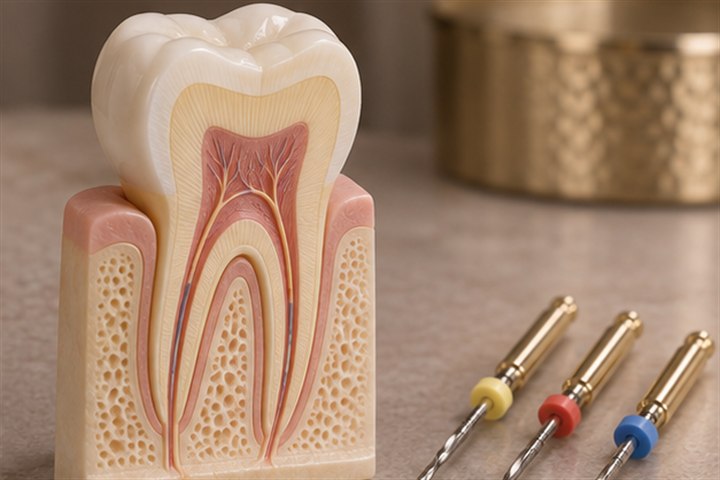
A thoughtful first step
When to seek an assessment
Dental needs differ from person to person. Share your concerns with the dentist, who can assess your case and discuss suitable options.
- Persistent pain or pain when chewing.
- Lingering sensitivity to hot or cold.
- Deep decay or an injury assessed by a dentist.
Clear, considered care
What the process may involve
Examine the tooth and review appropriate dental images.
Use local anesthesia when indicated, then clean and shape the canals.
Irrigate, dry, and seal the canals, then restore the tooth. A crown may be recommended depending on the remaining tooth structure and condition.
Helpful answers
Frequently asked questions
Does every toothache need a root canal?
No. Pain has many possible causes; examination and imaging help the dentist decide whether root canal treatment is appropriate.
Does treatment guarantee the tooth will remain?
No outcome can be guaranteed. The decision and outlook depend on the tooth's condition, assessment, and follow-up.
Will the tooth need a crown after root canal treatment?
The dentist may recommend a crown or another restoration depending on how much tooth structure remains, the tooth's position, and its condition.
How many appointments are needed?
The number of appointments varies with case complexity, the tooth's response, and the dentist's plan.
Which devices are used?
The clinic has an Eighteeth E-Connect Pro motor and Eighteeth FindPex apex locator. A general ultrasonic irrigation activator may be used when appropriate.
Speak with the clinic
Start with a question or assessment
First floor, Al Dweik Commercial Complex, Al Khareetah Roundabout, Al Yasmin, Amman.
Directions via Google Maps